
Knee Pain Physiotherapy in London
60-minute appointments to understand your knee pain, assess what is limiting you and build a clear plan for what happens next.
Knee pain can affect walking, stairs, squatting, running, gym training and sport.
Whether your symptoms started following an injury, developed gradually or keep returning when activity increases, we can assess the problem and help you understand your next steps.


When Should I Consider Physiotherapy for Knee Pain?
You may want to have your knee assessed if pain, stiffness, swelling or instability is affecting everyday movement, exercise or sport.
- Knee pain is affecting walking or stairs.
- Squatting or kneeling has become painful or difficult.
- Running is bringing on knee pain.
- The Knee feels unstable or gives way.
- Pain or swelling followed a sporting injury.
- Symptoms return whenever training increases.
- Knee pain is limiting gym exercises.
- They have been diagnosed with a meniscus, ligament or arthritic problem.
- Previous treatment has not produced the progress they expected.
- They are unsure what activity is safe to continue.
You do not need to know exactly what structure is causing your knee pain before booking.
During your first appointment we will identify what is the likely cause of your knee pain.

Knee Problems We Commonly Assess
Pain around or behind the kneecap that may be aggravated by stairs, squatting, running or prolonged sitting.
Symptoms that develop during or after running, particularly as distance, frequency or intensity changes.
Knee pain associated with suspected or diagnosed meniscus injuries, sometimes alongside swelling, clicking, catching or difficulty with deeper knee movements.
Knee problems following twisting, impact or sporting injuries where a ligament may be involved.
Pain, stiffness or reduced function associated with osteoarthritis or degenerative joint changes.
Problems affecting tendons around the knee, often associated with repetitive loading, running or jumping.
Pain, swelling, weakness or reduced confidence after a sporting or everyday injury.
What Happens at Your First Knee Pain Appointment?
Understand Your Knee Pain
We talk through how the problem started, how your knee behaves, what activities aggravate it, any previous injuries or treatment and what the problem is currently stopping you doing.
Assess What Matters
We assess the movement, strength and function relevant to your symptoms and goals. Depending on the presentation, this may include specific knee tests alongside functional tasks such as walking, squatting, stepping, running or other movements relevant to your activity.
Explain What We Find
We explain what the assessment findings suggest and what we think is happening. If you already have imaging, we consider that information alongside your symptoms and physical assessment rather than looking at the scan result in isolation.
Start Treatment or Rehabilitation
Where appropriate, treatment or rehabilitation can begin during the same appointment. What we use depends on your assessment and may change as your knee becomes ready for more demanding movement and exercise.
Build Your Plan
Before you leave, we explain what we recommend next, what you can do between appointments and how we will measure progress towards the activities you want to return to.
Do I Need a Scan for Knee Pain?
Not everyone with knee pain needs a scan before starting rehabilitation.
Many knee problems can initially be assessed without an MRI or X-ray. Whether imaging is useful depends on how the problem started, your symptoms, clinical findings and whether the result is likely to change what happens next.
If you already have an MRI, X-ray or medical report, bring it with you and we can consider the findings alongside your symptoms and physical assessment.
If you have not had imaging, you do not normally need to arrange a scan before booking unless you have already been advised to do so.
If your assessment suggests that imaging or another medical opinion would add useful information, we will explain why and discuss the appropriate next step.

How Do We Treat and Rehabilitate Knee Pain?
There is no single treatment programme for everybody with knee pain.
What we recommend depends on the problem, your symptoms, physical findings, current capacity and what you need your knee to do.Where appropriate, treatment may be used to help manage symptoms or improve useful movement while we begin addressing the physical demands of your problem.
If knee movement has become restricted, rehabilitation can work towards restoring the movement needed for everyday activities, exercise or sport.
Progressive exercise can rebuild strength around the knee and the wider lower limb based on your starting point and goals.
As your knee progresses, rehabilitation can become more demanding to prepare you for the loads involved in walking, stairs, lifting, running, jumping, changing direction or returning to sport.
Treatment Options Where Appropriate
- Laser Therapy
- Shockwave Therapy
- Exercise Rehabilitation
- EMS
- Infrared Cupping
- Vibration Therapy
You do not need to choose a treatment before your appointment.
Your practitioner will explain if a treatment above is appropriate for your condition.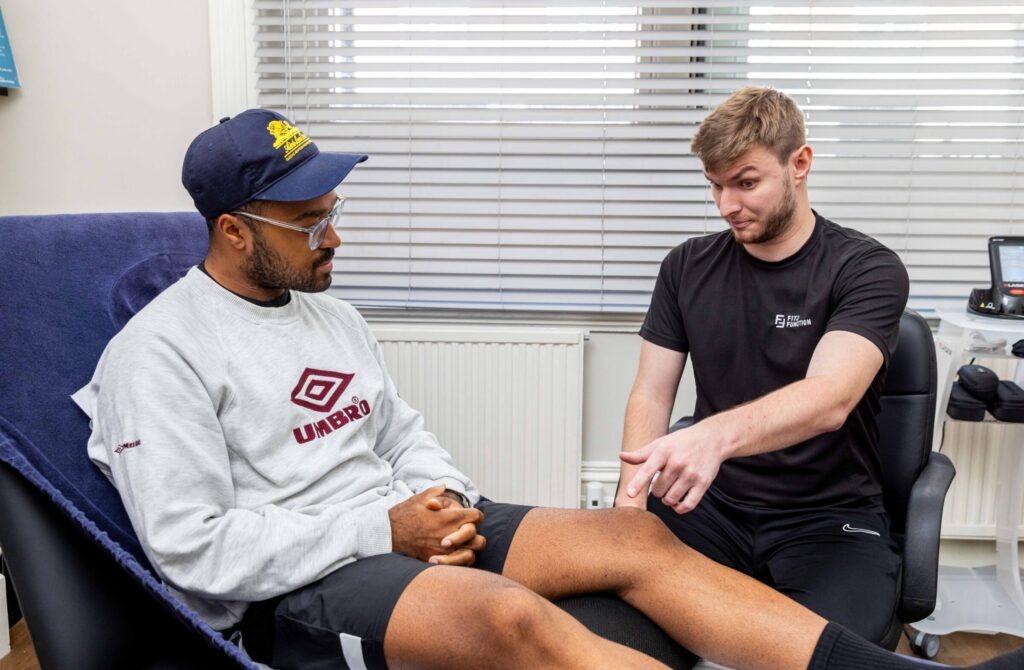
Our Approach to Knee Pain
Understand the symptoms, assess the knee and establish the most appropriate diagnosis or clinical explanation.
Where appropriate, address the immediate symptoms and limitations affecting you.
Build the movement, strength and physical capacity relevant to your knee problem.
Progress rehabilitation towards the activities and demands you want to return to.
What If My Knee Pain Isn't Improving?
Sometimes knee pain improves when activity is reduced but returns as soon as normal training, running or exercise resumes.
That can create a frustrating cycle:Pain
Rest
Feel Better
Return
Pain Returns
If progress is not matching what we expected, simply repeating the same treatment is unlikely to be useful.
We reassess.
That may involve:
- Reviewing how your symptoms and activity have changed
- Retesting movement, strength or function
- Reconsidering whether the working diagnosis still fit
- Adjusting your rehabilitation or activity
- Progressing your programme where appropriate
- Considering imaging or referral if the clinical picture suggests it is needed
If the situation changes, the plan should change with it.
EXCELLENT Based on 360 reviews
 Posted on Google

 Richard AbdyIn desperate need of some targeted physio, Fit2Function is very centrally located and handy for my workplace - in part of a huge gym above Covent Garden market (Better leisure centres, which I use in the suburbs). Over 6 sessions, Erica - great company and very reassuring - patiently coaxed my arthritic frozen kneecap back into position and strengthened atrophied inner hamstrings that no amount of walking would cure. Fantastic advice to set me in stead for the longterm too.Posted on Google
 Denis HallThank you, Erica, for all that you did to end long-running knee pain issues that regularly made my partner's life very difficult. We attended our first session with you wondering what to expect. But, as a result of your assessment, treatment and advice, the pain soon started to fade and the knee is now functioning normally. Thanks again for delivering such impressive results.Posted on Google
 Serkan UnluI would just like to say a BIG thank you to Anna - super knowledgeable, immeasurably patient (had to be with my ability to waffle), and honestly just an awesome person who will give you energy and keep you motivated to recover. As much as i miss working with Anna, I'm hoping I don't get injured again, but if I ever did, I'd absolutely be back here, my shoulder feels fully recovered and in fact in a far healthier place now than it ever has thanks to preventative exercises put into my exercise programme! So, if you are looking for a physiotherapist, genuinely just book here - Anna is living proof not all heroes wear capes 😌Posted on Google
 Alice Hilder JarvisErica really helped me sort my IT band problems - she was fab and I am so grateful!Posted on Google
 Lyanna AdianaHonestly no need to look anywhere else, book with Anna straight away! She is absolutely brilliant and the best physio in the world. I started working with Anna last year from having a spinal injury at L5-S1. In our initial consultation, she took the time to really understand my situation and was incredibly thorough. She built a recovery plan tailored to me, and I'm so glad I found her. My progress has been dramatic, I went from being on crutches (due to a weak left leg and my spinal injury) to doing my full daily routine again and even hitting the gym 3-4 times a week now! I still see Anna now for maintenance and to keep building strength in my leg, hips, core, and back. Beyond her clinical skill, Anna has a great sense of humour and is genuinely caring. She remembers every detail I've shared with her, which says a lot about how invested she is. At one point while still treating me, she was dealing with her own personal injury.. yet she still made the time and care to check in on me and continue my treatment! It's rare to find someone in London who cares this much about your wellbeing. I'm truly grateful to Anna and really appreciate her for the amazing person she is. I wish I could give 10 stars!Posted on Google
 Nikhita PatibandlaI highly recommend Anna! I reached out to her regarding some knee pain, and she tailored a fantastic plan to help strengthen my leg. Throughout our sessions, Anna was incredibly patient, encouraging, and insightful. I’ve had a great experience working with her.Posted on Google
 Irene TilliI went to see Erica for help with my sciatica that I was dealing with for a long time. Erica conducted a thorough assessment and came up with a plan to help me manage my symptoms and get my mobility back! I would definitely recommend going to see Erica for any problem you may have!Posted on Google
 Ase AnifowoseGlad I went to see Erica for my shoulder problem, she was able to relieve the pain I was experiencing and get me back into the gym and sport!Posted on Google
 Julia CorcoranI have been struggling with chronic low back pain for a long time, but since I started seeing Erica, I have noticed a massive change! I am now barely experiencing any pain at all. Thanks to her expertise, I was finally able to get back into the gym and lift without any worries or hesitation. If you are looking for a physiotherapist who genuinely gets results, I highly recommend Erica!Posted on Google
 Matt PizzeyI saw Erica for treatment after a knee injury, she was very professional and clear in what the recovery plan would look like. Our sessions in the gym were very useful to help me regain strength and eventually return to sport.
Meet Our Multidisciplinary Team Behind Your Recovery
Our Physiotherapy treatments are provided by our fully qualified Physiotherapists and practitioners. They are experienced professionals skilled in evidence-based rehabilitation techniques, ensuring your treatment is safe, effective, and tailored to meet your individual goals.
Knee Pain FAQs
How to relieve knee pain?
Knee pain relief starts with identifying the root cause of your pain. For most cases, rest, ice and elevation can help reduce acute inflammation. Physiotherapy exercises, advanced injury treatments, stretching and strengthening can also provide long-term relief.
What’s the difference between a knee strain, sprain, or ligament injury?
A strain refers to muscle or tendon injury, a sprain is an injury to ligaments and a ligament injury often involves a tear or rupture (e.g ACL injury). Our team at Fit2Function will diagnose your knee injury and work out the best treatment approach moving forwards.
How long does knee pain last?
The duration of knee pain depends on the cause. Acute injuries may heal in a few weeks with proper treatment, while chronic conditions like osteoarthritis may require long-term management and rehabilitation.
What exercises help with knee pain?
Strengthening the quadriceps, hamstrings and calf muscles can help support the knee joint. We provide a tailored exercise plan that includes low impact movements, strengthening and mobility exercises to improve function and reduce pain.
How does a Physiotherapy help with knee pain?
A Physiotherapist will assess your knee, diagnose the cause of your pain and guide you through exercises to improve strength, flexibility and stability. They will also use manual therapy to address joint restrictions and alleviate discomfort. Our Physiotherapists are also trained on all our advanced treatments.