


“Shin splints” is the common name usually used for medial tibial stress syndrome (MTSS), an exercise-related condition that causes pain along the inner border of the shin bone. However, not all shin pain is shin splints. A tibial bone stress injury, chronic exertional compartment syndrome and other lower-leg problems can cause similar symptoms, which is why persistent or severe shin pain should not automatically be treated as shin splints.
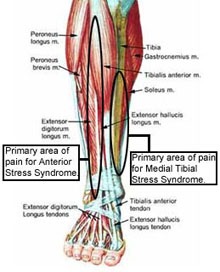
What Are Shin Splints?
Shin splints usually refers to medial tibial stress syndrome, often shortened to MTSS.
It commonly causes exercise-related pain along the inside of the tibia, or shin bone.
It is particularly common in people involved in activities with repeated impact, such as:
- Running.
- Football.
- Basketball.
- Netball.
- Dance.
- Military training.
- Other running and jumping sports.
Symptoms often develop after the amount or intensity of activity has increased beyond what the lower leg is currently used to.
What Does Shin Splint Pain Feel Like?
People with medial tibial stress syndrome commonly experience:
- Pain along the inner border of the shin.
- Tenderness across a relatively broad area rather than one tiny point.
- Symptoms during or after running and other impact activity.
- Pain that may initially improve when activity is reduced.
The exact presentation varies between people.
Importantly, more localised or severe shin pain can sometimes indicate a different problem.
Is All Shin Pain Shin Splints?
No.
This is the most important point in this article.
Several different problems can cause exercise-related lower-leg pain.
Three conditions worth distinguishing are:
1. Medial Tibial Stress Syndrome
Often referred to as shin splints.
↓
2. Tibial Bone Stress Injury
A stress reaction or stress fracture involving the tibia.
↓
3. Chronic Exertional Compartment Syndrome
Exercise-related symptoms caused by increased pressure within a muscle compartment.
They can sometimes produce similar symptoms, but they are not the same condition and should not be managed as though they are.
1. Medial Tibial Stress Syndrome
Medial tibial stress syndrome usually causes pain along the inside of the shin.
Symptoms are commonly associated with repeated impact activity and may develop following a change in training.
For example:
Running 10 miles per week
↓
Rapidly increasing to 25 miles per week
↓
Lower leg is exposed to considerably more repeated loading
↓
Symptoms develop
This does not mean there is one specific training increase that causes shin splints.
It simply demonstrates why recent changes in activity are useful to understand when assessing shin pain.
What Causes Shin Splints?
There is not one single cause.
The development of medial tibial stress syndrome is likely to involve a combination of factors.
These may include:
- Recent changes in training volume or intensity.
- Previous running injuries.
- Individual foot and lower-limb characteristics.
- The amount of impact activity being performed.
- The person’s current ability to tolerate that activity.
Research has identified several factors associated with an increased risk of MTSS, but this does not mean that every person with shin splints has one biomechanical problem that needs to be “corrected”.
The assessment therefore needs to consider the individual rather than simply looking for one supposed cause.
Does Overpronation Cause Shin Splints?
Not necessarily.
Some research has found an association between certain measures of foot posture and medial tibial stress syndrome.
However, this does not mean that everyone who pronates will develop shin splints or that pronation automatically needs to be corrected.
Your symptoms, training, previous injuries, strength, movement and activity demands all need to be considered together.
How Are Shin Splints Treated?
There is no single treatment that works for everybody.
Early management will often involve temporarily adjusting the activity that is aggravating the symptoms.
This might mean reducing:
- Running distance.
- Running frequency.
- Running intensity.
- Jumping volume.
- Other high-impact activity.
The aim is not necessarily to stop all exercise until every symptom has disappeared.
Instead, we want to find a level of activity the lower leg can tolerate and gradually build from there.
Do I Need To Completely Stop Running?
Not always.
The answer depends on how irritable the symptoms are and whether we are confident that the problem is medial tibial stress syndrome rather than a more significant bone stress injury.
Some people may need a period away from running.
Others may be able to temporarily reduce their training while maintaining other forms of activity.
As symptoms settle, running can then be progressively reintroduced.
The key is matching the amount of loading to what the lower leg can currently tolerate.
Exercise Rehabilitation In London →
What Exercises Help With Shin Splints?
There is no single exercise programme that everybody with shin splints needs.
Depending on what we find during an assessment, rehabilitation may involve working on:
- Calf strength and endurance.
- Lower-limb strength.
- Foot and ankle capacity.
- Balance and control.
- Gradual exposure to impact.
- Progressive return to running or sport.
Exercise should become progressively more demanding as symptoms and capacity improve.
For someone wanting to return to running, for example, rehabilitation should eventually prepare the lower leg for the repeated impact involved in running rather than stopping with basic exercises.
2. Tibial Bone Stress Injuries And Stress Fractures
A tibial bone stress injury occurs when repeated loading exceeds the bone’s current ability to recover and adapt.
Bone stress injuries exist on a spectrum.
Earlier stages may involve a stress reaction within the bone.
If the problem progresses, a stress fracture can develop.
This is different from medial tibial stress syndrome.
How Can I Tell The Difference Between Shin Splints And A Stress Fracture?
It is not always possible to reliably distinguish them yourself.
One useful difference is that medial tibial stress syndrome typically produces tenderness over a broader area of the inner shin.
A bone stress injury may produce more localised pain and tenderness.
As a bone stress injury becomes more significant, symptoms may also begin to occur with normal walking or other everyday activities.
However, symptoms can overlap.
If the pain is becoming increasingly localised, severe, persistent or painful during normal walking, get it assessed rather than assuming it is shin splints.
Does A Stress Fracture Always Show On An X-Ray?
No.
An X-ray may sometimes be used when a stress fracture is suspected, but early bone stress injuries may not be visible on a plain X-ray.
If clinical suspicion remains high despite a normal X-ray, further imaging may be considered.
MRI is particularly useful for identifying and grading bone stress injuries.
The appropriate imaging depends on the individual presentation.
What Should I Do If A Stress Fracture Is Suspected?
Stop trying to train through significant bone pain.
The appropriate amount of activity restriction depends on the location and severity of the injury.
Some people may need substantial temporary reduction in weight-bearing or impact activity.
Others may require different management.
The next step should be appropriate clinical assessment rather than simply waiting until the pain disappears and then immediately returning to training.
Returning to running or sport should be progressive.
3. Chronic Exertional Compartment Syndrome
Chronic exertional compartment syndrome is another possible cause of exercise-related lower-leg pain.
The muscles of the lower leg are grouped into compartments surrounded by relatively firm tissue called fascia.
During exercise, pressure within one of these compartments can increase and cause symptoms.
These may include:
- Aching or tightness.
- Burning pain.
- Pins and needles.
- Numbness.
- Weakness.
A typical feature of chronic exertional compartment syndrome is that symptoms appear during exercise and then reduce after the activity stops.
This is different from acute compartment syndrome.
Is Compartment Syndrome An Emergency?
It depends which type.
Acute Compartment Syndrome
Acute compartment syndrome can develop suddenly, often following an injury.
It can cause severe pain and requires urgent medical treatment.
Sudden severe lower-leg pain, particularly following an injury, should be assessed urgently.
Chronic Exertional Compartment Syndrome
Chronic exertional compartment syndrome generally develops during exercise and improves when the activity stops.
It is not the same emergency presentation as acute compartment syndrome, but persistent symptoms still require appropriate assessment.
When Should Shin Pain Be Assessed?
Consider getting your shin pain assessed if:
- Symptoms are getting worse.
- Pain is becoming increasingly localised.
- You have pain during normal walking.
- Symptoms repeatedly return when you run.
- Reducing your training has not helped.
- You cannot progress back towards your normal activity.
- You are unsure whether you have shin splints or a bone stress injury.
- You experience recurring tightness, numbness or weakness during exercise.
If you experience sudden severe lower-leg pain, particularly following an injury, seek urgent medical attention.
Do I Need A Scan For Shin Splints?
Not necessarily.
Medial tibial stress syndrome can often be assessed clinically.
Imaging becomes more relevant when:
- A bone stress injury is suspected.
- Symptoms are unusually severe or localised.
- The diagnosis remains uncertain.
- Symptoms are not progressing as expected.
- The result is likely to change management.
The purpose of imaging should be to answer a useful clinical question rather than simply because shin pain is present.
Can Physiotherapy Help With Shin Splints?
Physiotherapy can help establish whether your symptoms are consistent with medial tibial stress syndrome or whether another cause of shin pain should be considered.
Depending on what we find during your assessment, your plan may involve:
- Adjusting your current training.
- Building calf and lower-limb strength.
- Gradually increasing impact tolerance.
- Planning your return to running.
- Reviewing relevant movement or training factors.
- Monitoring how the shin responds as activity increases.
The aim is not simply to make the pain disappear temporarily.
It is to progressively rebuild what your lower leg needs to tolerate the activities you want to return to.
What If My Shin Pain Is Not Improving?
If your progress is not matching expectations, we reassess.
This may involve:
- Reviewing how your symptoms have changed.
- Retesting relevant movement and strength.
- Reconsidering whether the original explanation still fits.
- Adjusting your rehabilitation or activity.
- Progressing your programme when appropriate.
- Considering imaging if it is likely to change management.
- Considering medical or specialist referral if the presentation warrants it.
We do not want to simply repeat the same treatment indefinitely.
If the clinical picture changes, the plan should change too.
Still Struggling With Shin Pain?
If shin pain keeps returning when you run or exercise, or you are unsure whether you actually have shin splints, we can assess the problem and help you understand what to do next.
At Fit2Function, your first appointment lasts 60 minutes and gives us time to understand your symptoms and training, assess the lower leg, explain what we find and build a plan around what you want to return to.
Book Your Initial Assessment →